Published September 8, 2026 09:59AM
Forget Beer Pong: These College Students Are Running For Glory Across Campus
Across the country, college students are logging miles in their free time, racking up weekly half marathons and twice-a-week marathons.

BYU student Sam Johnson, right, has been running marathons around every BYU campus building. (Photo: Courtesy Sam Johnson)
Campus life can be hectic, and fitting running into a busy schedule isn’t easy. But college students Sydney Grogean and Sam Johnson, and recent graduate Joe Khalil are undaunted by the idea of balancing running and studies. With a little creativity and a whole lot of community support, they’ve been using running to foster connection, boost motivation, make a difference, and have some fun while they’re at it.
For Dartmouth College sophomore Grogean, the wheels began turning when, on a bike ride with her friend Finn Blankenship, he shared that he’d run a half marathon every Monday morning of his senior year of high school.
“That ride was the week before finals in May,” Grogean tells Outside Run. “I was already looking forward to the summer term when all Dartmouth sophomores have to be on campus. I’m on Dartmouth’s varsity rowing team, but there’s no practice over the summer. So I told Finn that I wanted to run a half marathon every Monday and invite others, giving us something social to look forward to each week.”
She emailed her runner friends and classmates, inviting them to join her and Blankenship for a “fun, chill 13.1-mile adventure” and asking them to RSVP “yes” by emailing a favorite poem.
Grogean urged her peers to participate in Half-Marathon Monday with a list of reasons that included: “At least 13.1094 weekly miles, coffee after, looking swag on Strava, and get to hang out with me and Finn.”
Grogean and Blankenship received nearly 80 poems in response. Not only did students RSVP “yes,” but they also replied all and added their friends to the email chain.
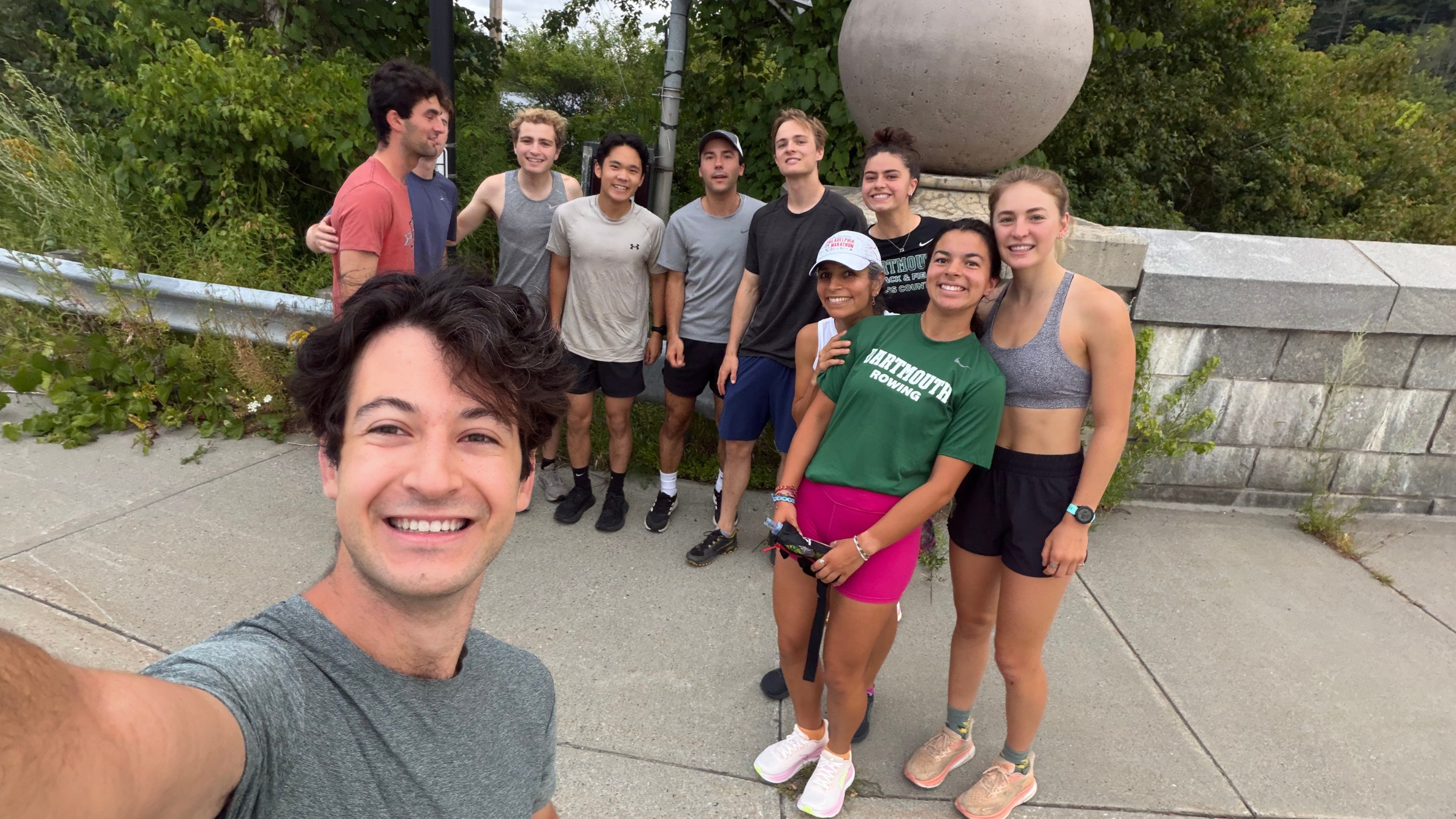
Grogean then organized start times of 5 a.m., 6 a.m., and 7 a.m. to accommodate students with different schedules. She runs with the 6 a.m. group, which typically includes five to 10 people. Other students who need to run later in the day go alone or with a friend. To keep everyone on the same page as well as boost motivation, Grogean created the group “Half-Marathon Monday” on Strava.
ADVERTISEMENT
“Even if you have to run by yourself, just seeing that your classmates were out there earlier, or knowing that they’ll be out there later, makes you feel like you’re part of something social,” Grogean says.
Her efforts to make running a weekly half marathon more accessible, which included setting up varying start times and using Strava to connect all the runners, paid off.
Over the summer, there were 1,000 people on the Dartmouth campus, and one in every 10 was on the Half-Marathon Monday email chain. As for the Strava group, it currently has 63 participants, a number that Grogean anticipates will grow as 4,500 undergrads return to campus for the fall semester.
“The best part is when you share miles with someone you haven’t had more than a five-minute conversation with in passing, and you end up having a super meaningful conversation over 13 miles and making a new friend,” Grogean says.
ADVERTISEMENT
Building a Community
On the other side of the country, it wasn’t a bike ride but finals week that sparked a running challenge idea for Sam Johnson, a Brigham Young University (BYU) student and marathoner. That idea quite literally spread across campus.
“During finals or whenever there are days when I get really busy and can’t run, I set the goal of just walking 10,000 steps per day,” Johnson tells Outside Run. “In April, I was at the library studying for finals. I realized it was 11:30 p.m. and I still hadn’t gotten my steps in. So I took a break and started walking circles around different buildings and thought, ‘What if I ran a marathon around the library?’”
While Johnson admits that initially the idea sounded like a crazy, finals week–fueled delusion, he couldn’t get it out of his head. Three weeks later, he decided to run a marathon around a square building on campus called the MARB and document it.
ADVERTISEMENT
“I called it the world’s first Marbathon,” says Johnson, whose Instagram video quickly garnered 100,000 views. Since then, he has run 12 on-campus marathons around BYU buildings, including the library, bringing the challenge full circle. After each one, he shares a post on Instagram, often asking his followers, “What building should I do next week?” BYU has 279 buildings on campus; some of Johnson’s marathons will include multiple buildings at a time.
What began as a fun way for Johnson to explore his own potential and push his limits has grown into a community of online followers helping decide on the buildings for his next marathons and on-campus supporters cheering for him as he runs around the buildings they study and work in. As many as 30 runners have even shown up to run some or all 26.2 miles with Johnson.
“I didn’t expect that, but now I have at least one person running with me every time,” Johnson says. “And I’ve had a few people tell me that they decided to start running or were motivated to run more because of the marathons, which in turn motivates me to keep this up.”
As of this writing, Johnson has been running one to two on-campus marathons a week. His most recent marathon went around three connected buildings.
ADVERTISEMENT
“The loop was half a mile, so I had to run 53 loops,” says Johnson, who plans to run 15 more marathons around campus buildings by the end of 2026, and looks forward to watching the running community that’s formed around his marathons continue to evolve.
“My favorite part of this experience is being able to connect with so many interesting and unique people I might not have met otherwise,” he says.
Running for a Cause
Around the same time that Johnson was contemplating how crazy it would be to run a marathon around his library, Khalil, a student at Wofford College in South Carolina, was proving that his own out-there idea was physically possible and incredibly beneficial to his community.
In December 2025, Khalil announced his intention to run 50 miles in a single day to raise funds for Miracle Hill Ministries and the Spartanburg Soup Kitchen. Others didn’t hesitate to call him crazy considering that at the time, the most he could run was “maybe a grueling 5K.” But for Khalil, running 50 miles didn’t sound as crazy as the issue of homelessness his community was facing.
“I had several encounters with unhoused people in my community over the summer,” Khalil says. “I knew them by name, built personal connections, and did small acts of service. They would tell me about how the shelter would get full or how the soup kitchen had limited hours.”
ADVERTISEMENT
Homelessness impacts more than 3,000 people in his hometown of Spartanburg, South Carolina, “So I came up with an idea to run 50 miles non-stop as a fundraiser for two organizations that use their funds to combat homelessness and food insecurity in our community.”
The challenge grew into “Go With Joe,” a fundraiser and day of service that included letter-writing for veterans, nursing homes, and hospital patients, a food drive, and a campus cleanup project that kicked off with a 5K. By the end of the day, Khalil had run 50 miles in around 11 hours.

“More importantly, over 2,000 items were donated, 250 letters written, and over $10,000 was raised for charity with the help of more than 100 runners, volunteers, and supporters,” he says. “I’ve also had the fortune of getting to know and grow closer to so many people because of Go With Joe.”
One of those connections is ultrarunner and Wofford professor Patrick Stanton.
“We’d meet over long runs, and now he’s my biggest mentor and a close friend of mine,” Khalil says. He’s now training for more ultras.
ADVERTISEMENT
“There’s a strange bonding effect that takes place when people endure exhaustion together,” Khalil says. “Running is an unmatched and uninterrupted way to spend time with others and experience life with friends or strangers.”
