Published October 23, 2026 12:06PM
I Ran a Half Marathon with a Human Coach, Then One with AI. Here’s What Happened.
AI coaching platforms are popping up everywhere, but how do they compare to their human counterparts? For me, the answer had more to do with accountability than pure performance.
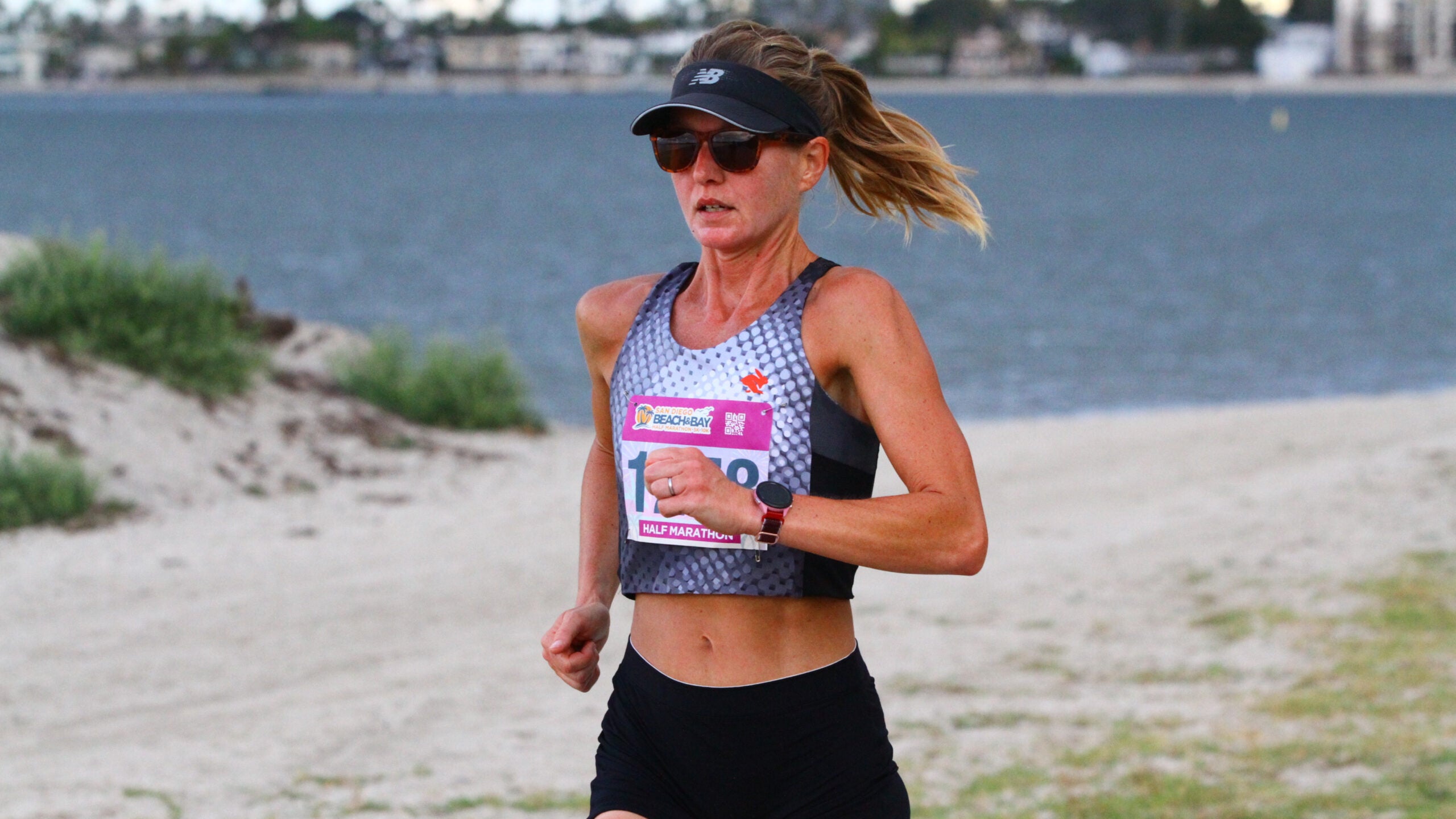
Claire Trageser runs the San Diego Beach & Bay Marathon. (Photo: SCS Photoworks)
SUMMARY:
- Claire Trageser ran two half marathons a few months apart, one with a human coach and one with an AI coach to evaluate which she preferred.
- The human coach provided tailored training, emotional accountability, and deep trust that kept Trageser motivated.
- Runna, the AI coach, offered an affordable plan at $10 a month, but its workouts didn’t feel as tailored, and watching it reduce goals or workout pace based on a poor workout was demoralizing.
I was about half a mile into my speed workout when I knew things were not right. I had glanced at the plan before I started running, and it seemed aggressive (800-meter intervals at 6:35/mile pace, which is faster than my 5K time and much faster than I’d run in a long time). But I figured I’d give it my best and see what I could do.
ADVERTISEMENT
Only after the first interval (which I managed at about 6:50 pace) did I realize this was a “rolling 800s” workout, and I was to do another 0.5 miles at 7:35 pace and then go straight back to 6:35 with no break. Four times.
I gave up about halfway through and finished the run at a conversational pace. I jogged home and immediately texted a friend, “Runna is trying to kill me.”
I’ve been running for more than 20 years, I’ve finished several marathons—including some with plans designed by a human—and I’m always up for a new challenge. But this was my first time trying to work with an AI coach.
I wanted to see what AI would come up with for me, and if I’d have the same motivation not to disappoint the robot in my phone as I did to not disappoint a living, breathing coach.
ADVERTISEMENT
AI-assisted coaching has exploded in recent years. It runs the gamut from people asking AI like Claude or ChatGPT for running plans to the supposedly more sophisticated systems like Runna, which costs about $10 a month and adapts a runner’s plan based on their performances—just like a human coach does. Within the app, little pictures of imaginary coaches with names talk to you and send you encouraging messages— “You’ve missed some workouts, but no stress!”—and suggest alterations to your plan based on how you’re doing.
Always up for being a human running guinea pig, I set up a little experiment. I trained for a half marathon using a plan created by a human coach who followed my progress and sent me a new running schedule every two weeks. Then I trained for another half using the guidance of Runna and its AI coaches.
Obviously this wasn’t even remotely a controlled experiment. I didn’t train for the same race, the conditions weren’t the same, and my body and fitness weren’t in the same place for each. As such, I didn’t focus on the performance outcome—knowing there are way too many variables to account for that. Instead, I wanted to evaluate the experience—look at what a human coach and an AI coach gave me, how each adapted as my training progressed, and whether my motivation was the same.
ADVERTISEMENT
The Human Coach
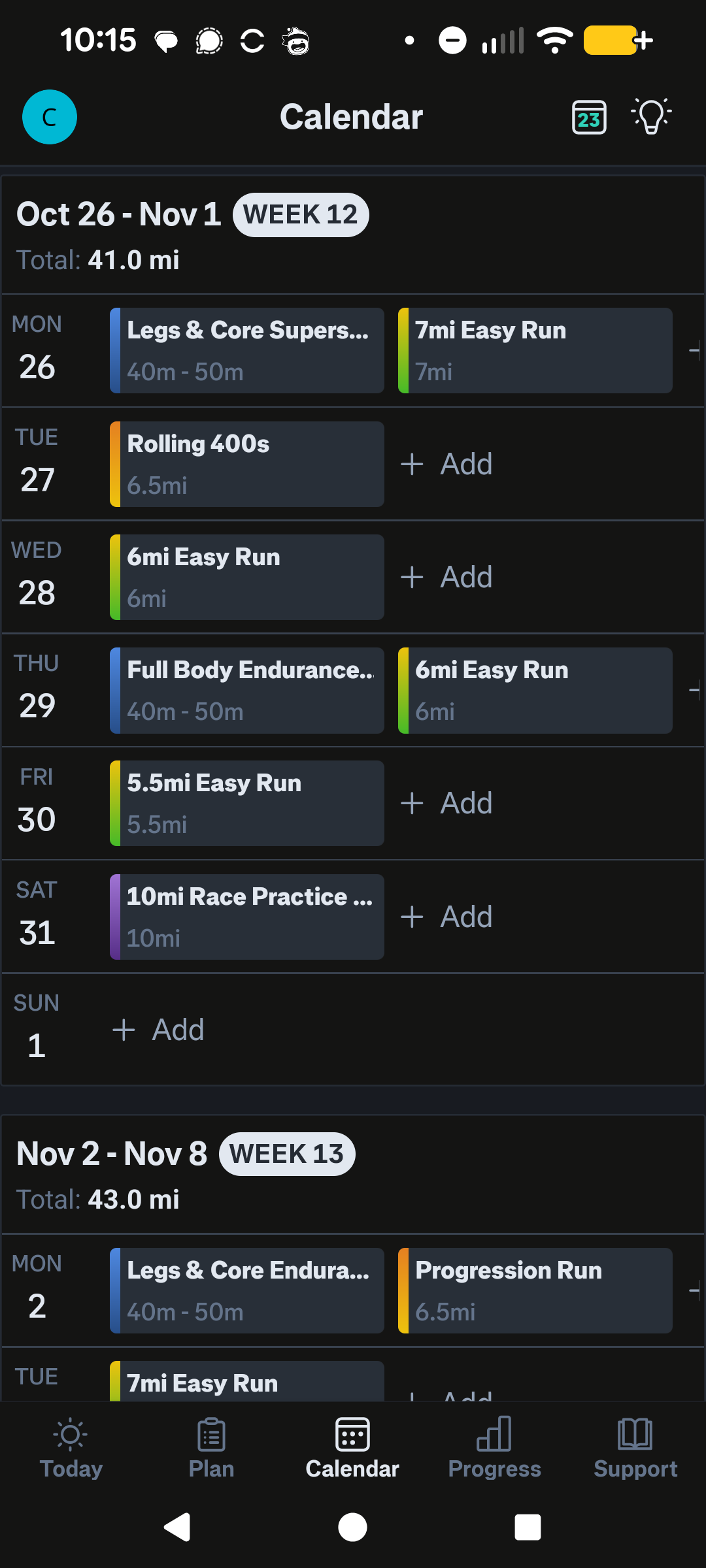
My first race was under the direction of Brian Maiorano, who has been coaching for 18 years and has helped me run a marathon PR in the past.
Maiorano uses intervals.icu to track his athletes’ training so he can see how they did on the workouts he designed. He then inputs the next two weeks’ schedule into the website, which can sync with your watch, so when you start running, the plan is already there. For his services, Maiorano charges $120 a month.
The intervals program helps him to not overload athletes, he said.
“But really that’s just a backup check to what my experience tells me,” he said. “And sometimes the software tells me that the athlete should be fresh, but it’s obvious from their splits or their remarks that they’re not. So it’s a tool I use as a rough guideline, not as a prescription.”
ADVERTISEMENT
Like most long-time coaches, Maiorano has a standard set of workouts that he’s developed, and has vast experience based on his past athletes along with books like Jack Daniels’ Running Formula and Tim Noakes’ Lore of Running.
“And I’ve had the luxury of picking the brains of coaches like Terrence Mahon and some of the other top minds in the field,” he added.
Maiorano himself uses AI a bit, not to develop individual workouts or weekly plans, but “as a chatting partner to explore training concepts and physiological outcomes,” he said.
“It can be a handy reminder of something I already knew, or an easy gateway to good references,” he said. “But for anything important I’ll follow links to actual references. Sometimes I find that the AI is just repeating something written on Reddit. The more esoteric the subject, the sketchier the references seem to be.”
For my plan, Maiorano started off by easing me in with some 4-minute intervals at 7:35/mile pace. When those went well, we built up to longer stretches at a 7:20–7:25/mile pace.
Every two weeks he’d send me an email assessing my performance, explaining what we’d be doing next and why, and sending helpful pointers and tips. For example, pushing the pace in tempo intervals will help prepare my body for the fatigue I’d feel at the end of a race.
I am a people-pleaser by nature, and always want to be the straight-A student. So when I have a human coach who I know will be looking at my performance after each run, it’s a major motivation to do my best. Even when I couldn’t sustain a pace in a tougher workout, I’d push as hard as I could, knowing that Maiorano would check later—and I inherently wouldn’t want to disappoint him.
That human connection matters to him, too, because he views coaching as far more than just writing training plans. He likes to have video calls before a runner starts working with him, during the training plans, and before a race, and Maiorano is especially diligent about including exercises to strengthen certain muscle groups and prevent injury.
“If all an athlete needs is a schedule showing how many miles and what pace to run each day, AI is probably good for that,” he said. “But coaching involves evaluating capabilities and potential, setting goals, teaching skills, instilling confidence, training the brain, hardening against injuries and aiding recovery from those that do happen, and encouraging the athlete through low points.”
ADVERTISEMENT
And to do that well means forming a personal connection with the athlete that’s born out of a mutual trust and a shared desire for the best performance, he said.
“Athletes who hire coaches tend to have a lot invested in their goals, a lot of their self-esteem can be tied up in reaching those goals,” he said. “So from the athlete’s perspective, it can feel incredibly vulnerable to trust a coach with such an important part of themselves. And from the coach’s perspective, it’s a unique gift to be entrusted with something so deeply personal and important.”
This is true for me. I am conservative with my running goals, and when I first started working with Maiorano, he looked at my past performances and suggested I could run a marathon at a 7:45/mile pace. I didn’t believe him, but decided to give it a try. Through his training program, I ended up crushing my marathon at that exact pace—something I never would have attempted on my own.
ADVERTISEMENT
For this half marathon, he suggested what I thought was equally ambitious—a 7:20–7:25/mile pace, which I’d only managed in a 10K a month before at less than half the distance. But given my history with him, I trusted him and gave it a try.
When I did struggle with workouts over a certain week, or reported that I was feeling fatigued, Maiorano made alterations quickly, lowering paces a bit or backing off mileage. But overall, I was able to sustain his workout plan and felt myself knocking out runs I wouldn’t have thought possible.
I headed to the start line of the half marathon about three-and-a-half months later and edged out a small PR, running a steady 7:20-7:25/mile pace throughout and finishing with a strong kick at the end. It felt incredible, and I couldn’t wait to email Maiorano and let him know how I’d done.
ADVERTISEMENT
“Let’s face it, as a runner, few others care about how fast or how far we run,” he said. “Maybe our partner or our mom will care a bit, but only to the extent of learning if we’re happy with our race or not. But your coach cares, probably as much as you do. And knowing that someone cares means a lot when times get hard.”
That feeling that someone is watching you sounds creepy, but when it’s your running coach, it’s like little Jiminy Cricket on your shoulder telling you to let your power be your guide. Knowing someone cares helps you care too. When you’re at mile 23 of your marathon and the world seems like nothing but one big house of pain, you know that your coach is tracking you online and will be affected if you don’t make your goal time. Your coach’s emotional investment spurs you to figure out how to dig deep and finish strong.
The AI Coach
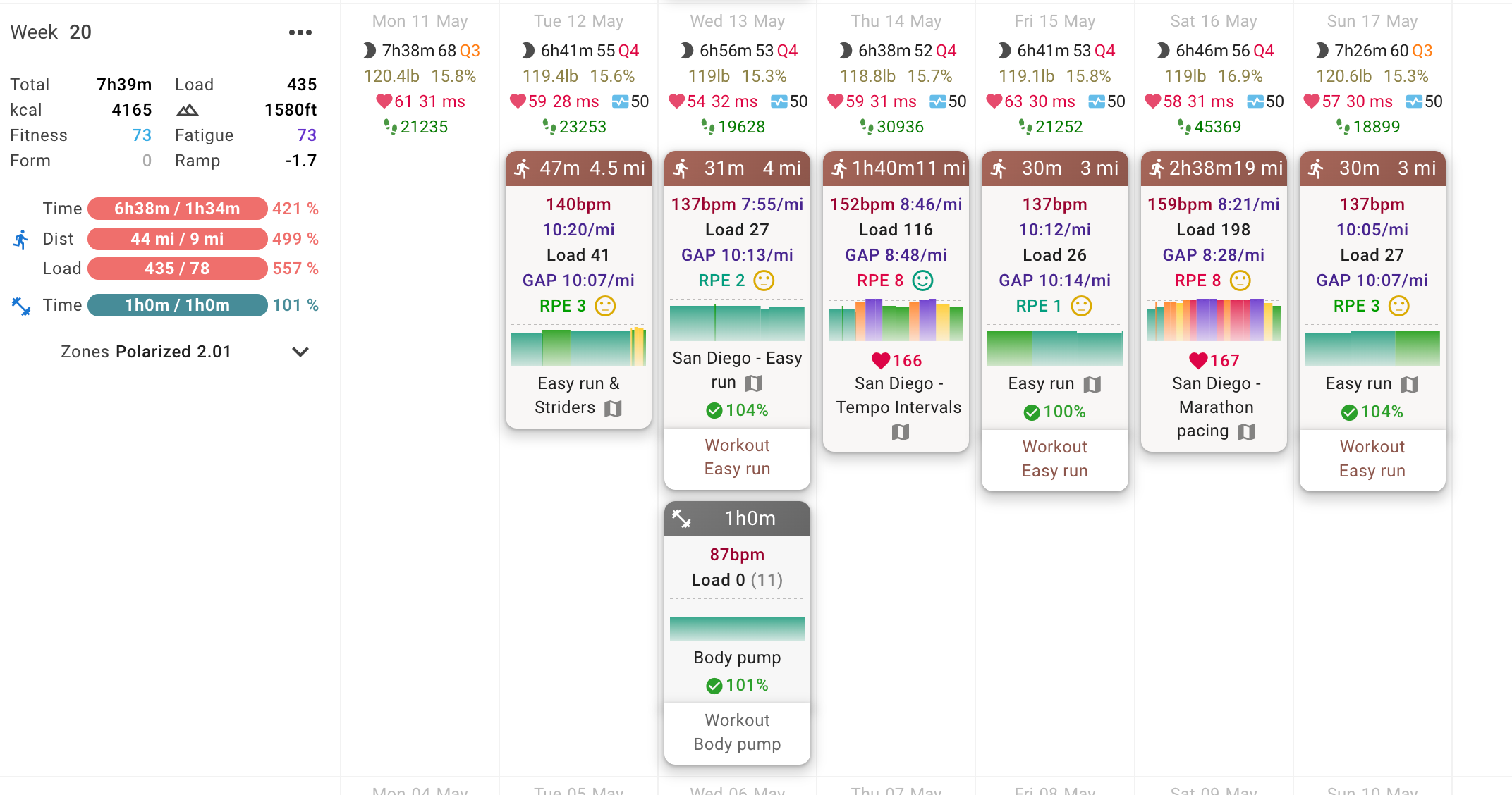
After my PR at the half marathon, I gave myself a bit of a break and then downloaded Runna. It asked for my past performance and goals, and together we put another half marathon on the calendar about four months out. Given my PR, it suggested running the half at a 7:15/mile pace, which sounded good to me. It also asked for my running preferences, like what day of the week I do a long run, what days off I want, and how often I want to do strength training. After inputting all of this, it developed a plan for the next four months.
A week later, I found myself in that seemingly impossible “rolling 800s” workout, feeling like the imaginary coach was trying to kill me.
ADVERTISEMENT
While the plans were all laid out for the next four months, that doesn’t mean they’ll stay set in stone, Runna head coach Steph Kessell told me. Instead, they’re meant to adapt as the AI assesses your performance.
“No runner is the same, so we don’t think people should follow a one-size-fits-all plan,” she said. “That’s why we created the ability for our plans to adapt, and they do so based on two main elements: data from completed sessions and real-world performance, and user feedback.”
As a runner goes through Runna’s plan, they provide feedback like “Not Feeling 100%,” which tells the app they’re not feeling well, managing an ache, or simply dealing with the business of life, Kessell said. The app also offers the “Pace Insights” feature, which compares how runners perform in speed sessions against the paces set in their plan.
“If a clear trend is detected, a recommendation is surfaced to bring training paces in line with current, real-world performance, which makes sure they’re training in the correct zones according to their ability,” Kessell said.
ADVERTISEMENT
After my failed 6:35/mile pace workout attempt, the app quickly suggested I modify my expectations for the race and redesigned an entirely new training plan with less aggressive paces. My pride was hurt, and it didn’t match up with what my instincts told me: My inability to run 6:35/mile pace over two miles didn’t seem like a fair assessment of whether I could run a 7:15/mile pace half marathon. But that’s all part of the process, Kessell said.
She explained that the app can recognize clear trends when things aren’t working (or via feedback) and make adjustments.
Kessell added that the entire plan is fully adaptable by the runner, so even if the app suggests downgrading a goal, you can override it, but of course that’s different than talking through a change with a human coach and weighing the pros and cons.
Given my people-pleasing nature (even though I knew no human was checking my performance after each run), I still wanted the imaginary coaches to give me kudos when I finished a run. So I stuck to the new program, following it as closely as I could, and it slowly adapted to suggest more reasonable workouts, like rolling 800s that alternated between 7:15-7:55/mile pace.
ADVERTISEMENT
Still, I often questioned its decisions, like giving me “long runs” of only 5.5 miles a few months before my race. It didn’t seem to be building up mileage in the way my human coach Maiorano did, and it didn’t seem to create steady or predictable tempo workouts built around my race pace goal.
The people behind Runna know that AI isn’t the same as a human, and that one of the big differences is that we feel greater accountability to a human, Kessell admitted.
“However, motivation comes in different forms,” she said. “A training plan can inspire people in itself by taking away the guesswork of how to train, and that’s where the recent use of AI to generate training plans comes in.”
Given the running boom, it makes sense that there are programs like Runna’s out there, which at $10 a month are far cheaper than a human coach. And Runna is hoping to be a step above other AI-based plans like runners chatting with Claude or ChatGPT, Kessell said.
ADVERTISEMENT
“Our plans are personalized to each runner and adapt around people’s lives,” she said. “They’re also developed by experienced coaches using established training principles, incorporating insights from years of supporting runners on their training journeys.”
If I missed a workout, I did notice the imaginary coaches in the app would reassure me that it’s OK, life happens, and suggest modifications to my plan. But that doesn’t feel the same as a coach like Maiorano who knows me personally, knows my history with running, and has a better sense of what I’m capable of.
As I toed the line for my second race, the one where I trained with AI, I was pretty unsure of how I’d do. I was overall fresher when I trained with a human, and was able to keep my mileage higher. So I wasn’t expecting the same results. But I also felt like my AI training plan had been much more all over the place, with random workouts that were either too fast (like those 6:30 repeats) or too slow (running 2.5 miles at 8:30 pace, for example).
ADVERTISEMENT
With Maiorano, I felt like I had a consistent goal, and when he sent me a new schedule every two weeks, he took the time to explain what the workouts were and what they were geared toward achieving. The Runna app would refresh my training calendar based on my past performance, but if I had an off day, it would downgrade the entire plan to slower paces.
I ended up running a decent time in my second half marathon, but not close to the PR I had run on my last attempt, and I had lots of questions swirling in my head before, during, and after the race—something I didn’t experience with Maiorano.
Human Run Coach Vs. AI Run Coach Personal Conclusion
Since this was nowhere near a controlled experiment, I can’t say if the end result was because of my overall training cycle and fitness or the physiological effects of the AI-generated training plan, or a combination of both.
But I can tell you the way I felt: With AI, the nearly impossible workout targets felt frustrating, and then the seriously downgraded goals and expectations (without discussion) felt demoralizing. With my human coach, I felt a connection that both motivated me to not disappoint him but also instilled a level of confidence and understanding that, as runners, we need to have on race day.