Updated October 23, 2026 11:52AM
If You're Running the New York City Marathon, You Need This Champion-Backed Advice
Germán Silva and Abdi Nageeye know how to navigate chilly temps, the five bridges, and a notoriously tough finish.
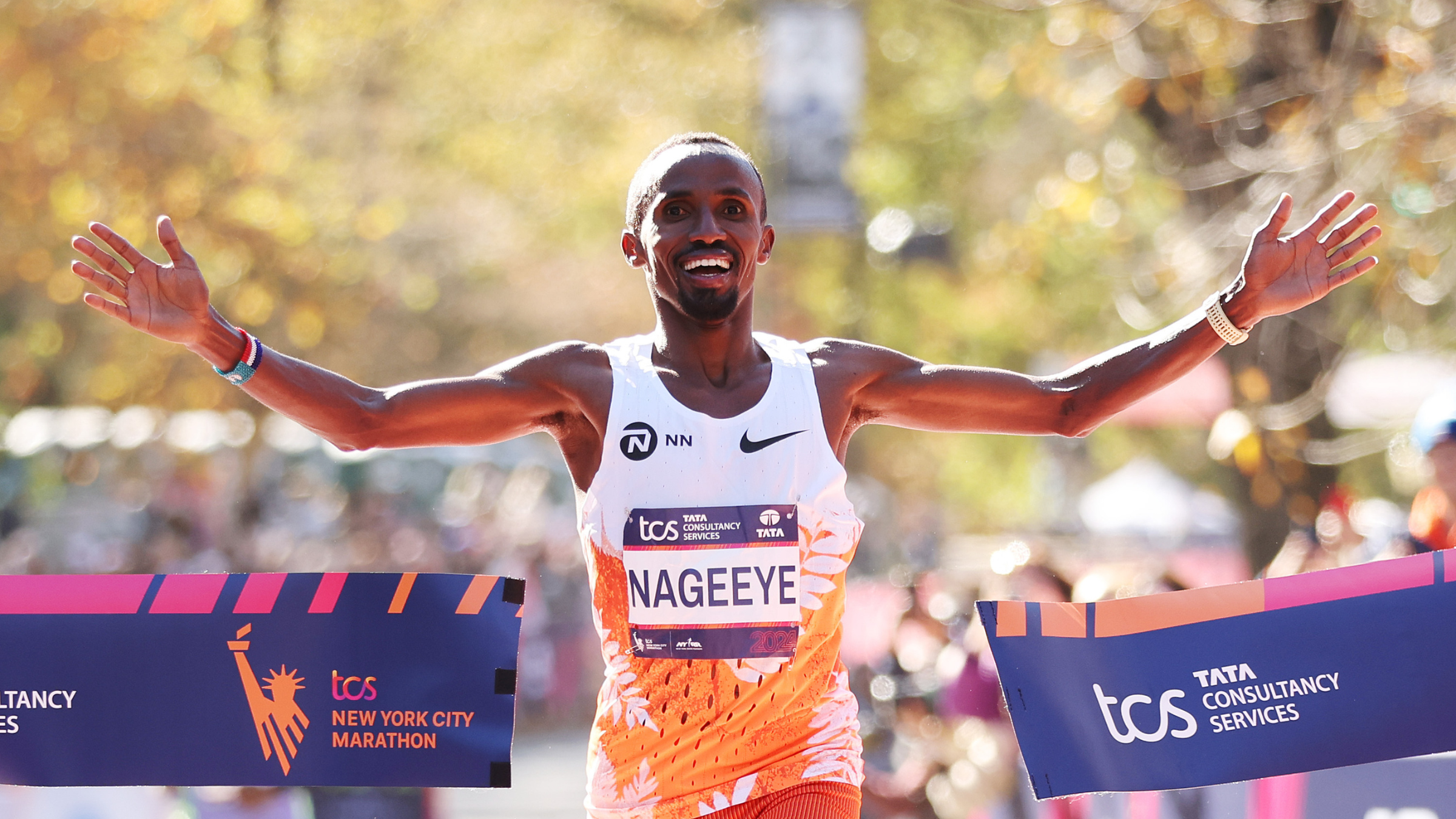
(Photo: Getty)
On the first Sunday every November, New York transforms into a massive block party across all five boroughs in honor of the iconic New York City Marathon, one of the world’s most celebrated sporting events.
The first edition of the marathon, in 1970, had runners loop Central Park a little more than four times. There were 55 finishers. This year, though, marks the 50th anniversary since the course expanded to cover the five boroughs in 1976. The storied race has ballooned to nearly 60,000 runners from more than 100 countries.
“The city embraces the marathon,” says Somali-Dutch runner Abdi Nageeye, an Olympic silver medalist who won the New York City Marathon in 2024.
Nageeye considers the New York course more demanding than the Boston Marathon. “It takes people out so easily,” he tells Outside Run.
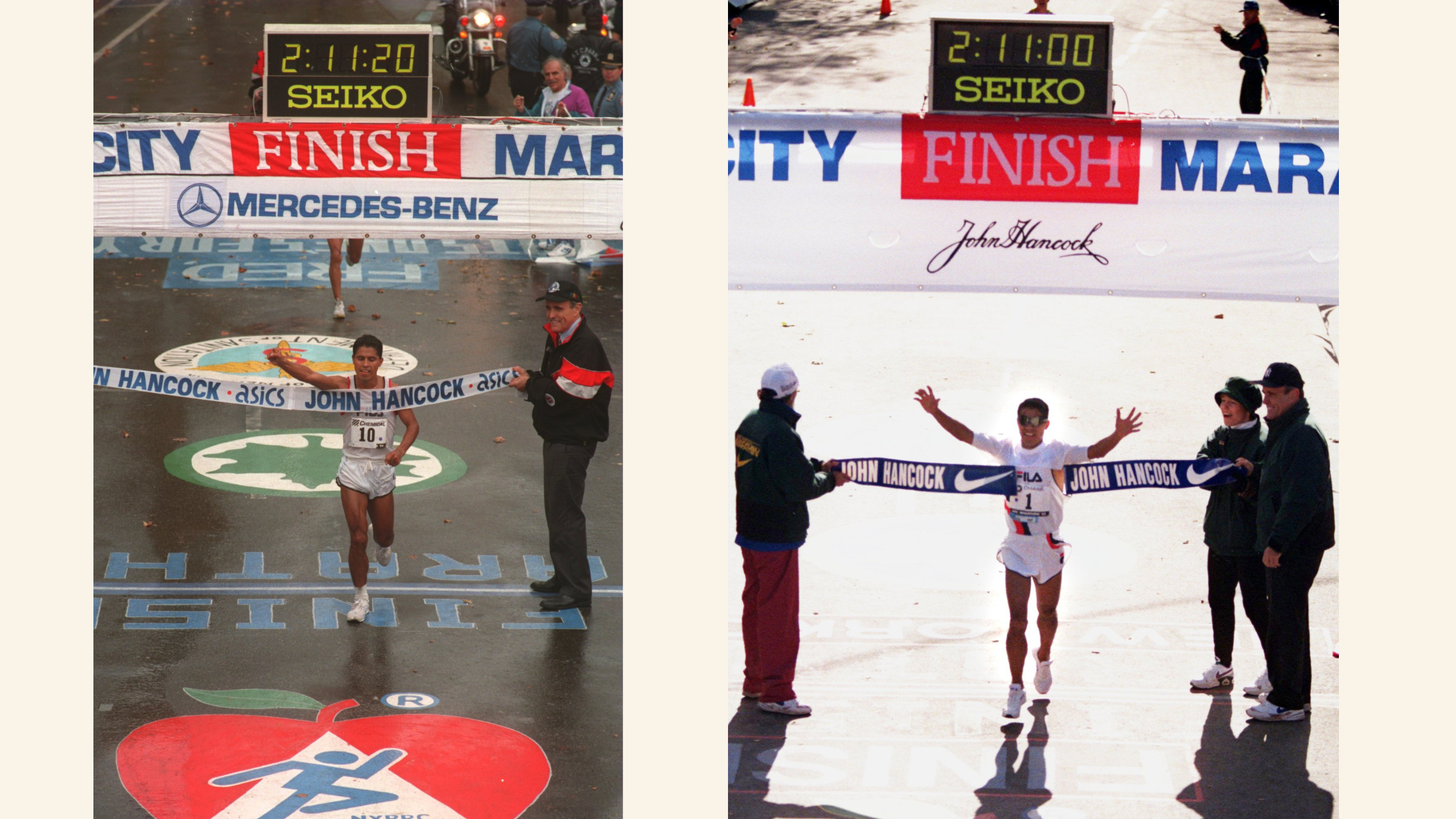
Olympian Germán Silva, who won back-to-back titles in New York in 1994 and 1995, agrees:
“Boston is not easy, but for me in particular, it’s more easy than New York. From the beginning you can feel how hard the course is.”
Nageeye will make his sixth appearance on the starting line this year. He enters the race with a personal best of 2:04:20 (a Dutch national record) as he aims for a spot on the podium. He and Silva offered their expert insights on tackling the course and getting to the finish line smoothly, no matter your pace.
ADVERTISEMENT
Wrap Up in Wool
Race morning in New York can be a test in itself before the marathon begins. Not only is it an adventurous haul to the starting line in Staten Island by way of bus or ferry, temperatures can hover around mid-40 degrees. Depending on your transportation arrangements and start wave, you could spend a few hours outdoors in Staten Island before your race start.
Sleeping bags, duvets, and large blankets are prohibited, per race rules. But that doesn’t mean you should brave the cold without an extra layer, Nageeye cautions, adding that running in cold temperatures may induce side stitches. “I recommend to have thick clothes that’s maybe secondhand,” he says.
Find a wool layer that you don’t mind leaving behind when the race gets underway. Wool fibers are made primarily of keratin, and their naturally crimped structure traps pockets of air, which helps to insulate body heat. Fortunately, New York has plenty of resale shops where you can hunt for affordable threads. Try Buffalo Exchange or Beacon’s Closet, both of which have locations in Manhattan and Brooklyn.
ADVERTISEMENT
Let Go of the PR
Hear us out. Courses like Chicago, Berlin and London are designed to give you an opportunity to run fast, thanks to their flat courses. New York is not as gracious, with just over 800 feet of elevation gain and equal descent. Your legs will feel the hills. “I know very few people who do their PR in New York,” Silva says.
While it’s not impossible to run fast (the men’s course record is 2:04:58, while the women’s record is 2:22:31), the fact that the route is full of bridges and hills makes it more of a tactical effort. The key to running a strong race, Nageeye says is, “Don’t think too much about the time.”
“New York is a race where when you go there, you have a different strategy,” says Nageeye, who will compete alongside two-time champion Geoffrey Kamworor of Kenya.“It’s more [about] surviving those five bridges.”
ADVERTISEMENT
Start Conservatively
Even if you’re hellbent on setting a PR in New York, you’ll want to hold back in the early miles.
“From the beginning you can feel how hard is the course,” Silva says.
The route is deceptively challenging in the opening uphill mile on the Verrazano Bridge. Here is where to remain calm, collected, especially as you head into Brooklyn in the second mile, where the course shifts to a steady decline. “You have to control not going too fast, not to damage your legs from the beginning,” Silva says.
Nageyee’s advice is to look ahead without getting too swept away by the estimated 2 million spectators along the course. Keep reminding yourself: the bridges are coming. (More on those in a minute.)
“I would recommend to run the first 10K really easy. By 10K, 15K, there is so much crowd [noise]. You really need to keep your pace,” Nageyee says.
ADVERTISEMENT
Regardless of your pace or target finish time, Silva emphasizes the importance of staying in control of your pace. This is especially true as you reach First Avenue around mile 16, where the excitement can tempt runners to go too fast. “It’s so long. It’s a little bit tricky because you feel like you are going down [hill], but that’s where the course is a little bit hilly,” Silva says.
As Silva reminds runners, the marathon truly begins much later, around mile 22 (37K). If you push the pace too early, “you are going to pay the price,” he says.
Nageyee adds, “I think everyone has his own thing. For me, it’s like just wait for the kilometer. Let’s survive 40, 41. When you run a good race, […] you have this flow and you can go really strong. You can only do that if you run very smart at the beginning,”
Break the Course Into Blocks
A marathon is as much a mental challenge as a physical one, and strategy is crucial, Silva says. So he breaks the New York course into three blocks, counting down the miles to make the distance seem more manageable. The first block takes him from the start to mile 10, the second to mile 20, and the final six miles he approaches like a morning run as he counts down to the finish line.
ADVERTISEMENT
“Instead of thinking, ‘It’s still 6 miles to go,’ mentally, what I always do is, OK, it’s 6, 5, 4, 3,” Silva says. “And when you reach two [miles to go], physically, that’s the hardest part. You have to play those tricks with your mind.”
Mind the Bridges
The five bridge crossings are a defining feature of the New York City Marathon, and each presents a different challenge at a different stage. Runners first cross the Verrazzano-Narrows Bridge in Staten Island as they head to Brooklyn, followed by the Pulaski Bridge into Queens. Next, the Queensboro Bridge takes runners into Manhattan before the Willis Avenue Bridge into the Bronx. The Madison Avenue Bridge brings runners back into Manhattan for the homestretch.
When Silva competed in the NYC Marathon in 1995, he faced wind gusts of 21 to 32 mph on the Verrazzano-Narrows Bridge.
“Definitely Verrazzano Bridge can be so windy. You can feel that it blows you away,” Silva says. “Try to be in a group that is going your pace. It’s hard to challenge the wind by yourself.”
ADVERTISEMENT
Of all the bridges, Nageyee suggests paying particular attention to Queensboro. “That one is the hardest one. That’s where the Kenyans go really fast. They go hard downhill. It’s scary sometimes. I was dropped twice. So that one for me is the toughest. Focus there. Go down fast, but not too crazy,” Nageyee adds. “Don’t forget, after all of these bridges, you have [hills in] Central Park.”
A calculated approach is the key to having enough power to finish strong, he says. Nageyee understands the value of patience required to make a late move. In 2024, he surged in Central Park with roughly 600 meters remaining and won the race six seconds ahead of Kenyan Evans Chebet.
For Silva, the Queensboro Bridge is also “a good moment to make a reflection and be with yourself in terms of analyzing how have you been doing,” he says.
Drink — Even if You Don’t Feel Thirsty
Hydration can be easy to overlook when the weather is chilly. While elite runners have the luxury of having their bottles prepared for them at designated points along the course, they have little control over the temperature of their drinks. Nageeye, however, has a technique for handling cold fluids.
“Don’t just take cold water and drink too fast. That will be really bad for your stomach. You can get [side] stitches,” he says. “Drink really slowly to make it a little bit warm in your mouth and then swallow it.”
ADVERTISEMENT
For runners relying on course-provided refreshments, water and Gatorade Endurance Formula are available from mile 3 to mile 25 (with the exception of miles 5, 7, and 9). Runners carrying their own hydration systems can also refill at designated self-service water stations along the course (miles 8, 14, 17, 20, and 23). Note: Race rules stipulate that only hydration vests with front bottles of one liter or less are permitted.
Recalibrate
In 1994, with less than a mile to the finish line, Silva ran stride for stride with his training partner and competitor, Benjamin Paredes, to lead the race. The pair had been following a motorcycle filming them, but when the motorcycle turned right to leave the course, Silva followed, veering off course.
By the time he realized his mistake, 12 strides later, he opted to grit it out, and he went on to surpass Paredes to win the race by two seconds. Silva’s experience is a reminder that even in a race as carefully planned as a marathon, unexpected moments can happen. When they do, his advice is simple. Stay calm, keep putting one foot in front of the other, and visualize.
“Anytime things are difficult, think [of] yourself crossing the finish line,” Silva says.